Firstly, hearty congratulations to L.V. Pederson for writing such a blockbuster of a debut thriller. “Nine Minutes Eleven Seconds” is the title of Pederson’s fast- paced novel published in January 2025. Guess what? Pederson worked as a film censor in Canada and a script writer in Hollywood, apart from being an entrepreneur and innovator! He brings all these experiences to bear in this thriller which I enjoyed reading!
The story begins with a young, attractive lady called Madison Maxwell joining Know Inc, one of the most renowned tech firms in the world. This, of course, is situated in the Silicon Valley. Madison wants to put her past life at Boston behind her- to make a fresh start in a place which seems so promising. She feels this firm and her position as Executive Assistant to the Vice President would fulfil her career dreams. The plot of the story that unravels is crisply woven together with apt back stories. This makes for very exciting reading.
Shortly into the job, Madison comes across people who are totally different from who they at first appear to be. She comes across several mysteries in that firm which folks don’t talk about. Circumstances force her into situations which test her endurance to the limits. To complicate matters further, there is a deeply personal angle from her past which resurfaces to haunt her.
The story brings back to the reader memories of that unforgettable tragedy- the 9/11 terror attacks on the United States. It is a gripping story which you must read for yourself! Highly recommended.
Over the last few decades, I stay glued to the television on India’s Republic Day -January 26- to see the parade. This year too I look forward to the parade. Most of all I am waiting to see and pay homage to the three surviving winners of the Param Vir Chakra. This honour is India’s highest military honour and is like the Victoria Cross in the UK or the Medal of Honour in the United States. The memory of the Param Vir Chakra winners was triggered by a book I read recently. It is called, “The Brave: Param Vir Chakra Stories” by Rachna Bisht Rawat. She is a journalist and writer with a family background steeped in military history.
This book was one of the early books about the Param Vir Chakra winners. It was first published by Penguin in 2014. Since then there have been many more books on these national heroes. Since I am fascinated by these stories this book was of considerable interest to me. Thanks to the internet and the media, in recent years many of them have become household names, like Capt Vikram Batra of Kargil War fame. However, to be honest, I am ashamed to say that some of the early winners of the Param Vir Chakra were unknown to many in my generation. One of them was Major Rama Raghoba Rane of the Bombay Sappers who got his PVC in the Indo-Pak Kashmir War in 1947. He was one of the rare braves who lived to receive his award. Most of the Param Vir Chakras were awarded posthumously. This means the winners of the nation’s highest gallantry award made the supreme sacrifice while carrying out their acts of bravery.
All the winners were worthy of the high honour bestowed upon them by a grateful nation. It would be unfair to single out one or the other from amongst them. However, we are humans and cannot resist having our favourites. Mine have been Major Shaitan Singh of 13 Kumaon of Rezang La fame during the Indo-China War of 1962 and 2nd Lt Arun Khetarpal of 17 Horse, who won his award in the Indo-Pak war of 1971. Mention must be made of Flying Officer Nirmal Jit Singh Sekhon, 18 Squadron, IAF, who won his PVC during the Indo-Pak War of 1965. Till date, he remains the only Param Vir Chakra awardee who was not from the Indian Army.
Ms Rawat has written about the battles in which the heroes won their awards and about these men themselves. Their stories have been pieced together following interviews with family, colleagues, superior officers and others who could speak authoritatively about their feats and about themselves as persons. Overall, it was well written as it focussed as much on the human element of the awardee as it did on their feats of incredible bravery facing all odds.
These errors may have been corrected in subsequent editions but the Kindle version of the book I read had two which were unexpected. It is stated that “Nehru appointed Lt Gen B M Kaul as Chief of Army Staff in 1961”. Gen. Kaul was undoubtedly his favourite and perhaps informally overshadowed the then Chief of Army Staff, General P N Thapar but he was never the Chief of Army Staff. It also refers to the late Capt Saurabh Kalia of 4 th Battalion, Jat Regiment , as Major Kalia. Capt Kalia, you may recall, was perhaps the first casualty of the Kargil War. He was cruelly tortured by the enemy. I am not aware of his promotion to Major nor could I find this substantiated anywhere. These are minor glitches in what’s otherwise a good read. I wish more of our youth read this book to be inspired by these heroes.
And yes, please do watch the Republic Day Parade on January 26 to salute the surviving three Param Vir Chakra winners: Sub Major (Hon. Capt) Bana Singh, 8 J & K Light Infantry; Subedar Major(Hon. Capt) Yogendra Singh Yadav, 18 Grenadiers; and Subedar Major (Hon. Capt) Sanjay Kumar., 13 JAK Rifles. Jai Hind!
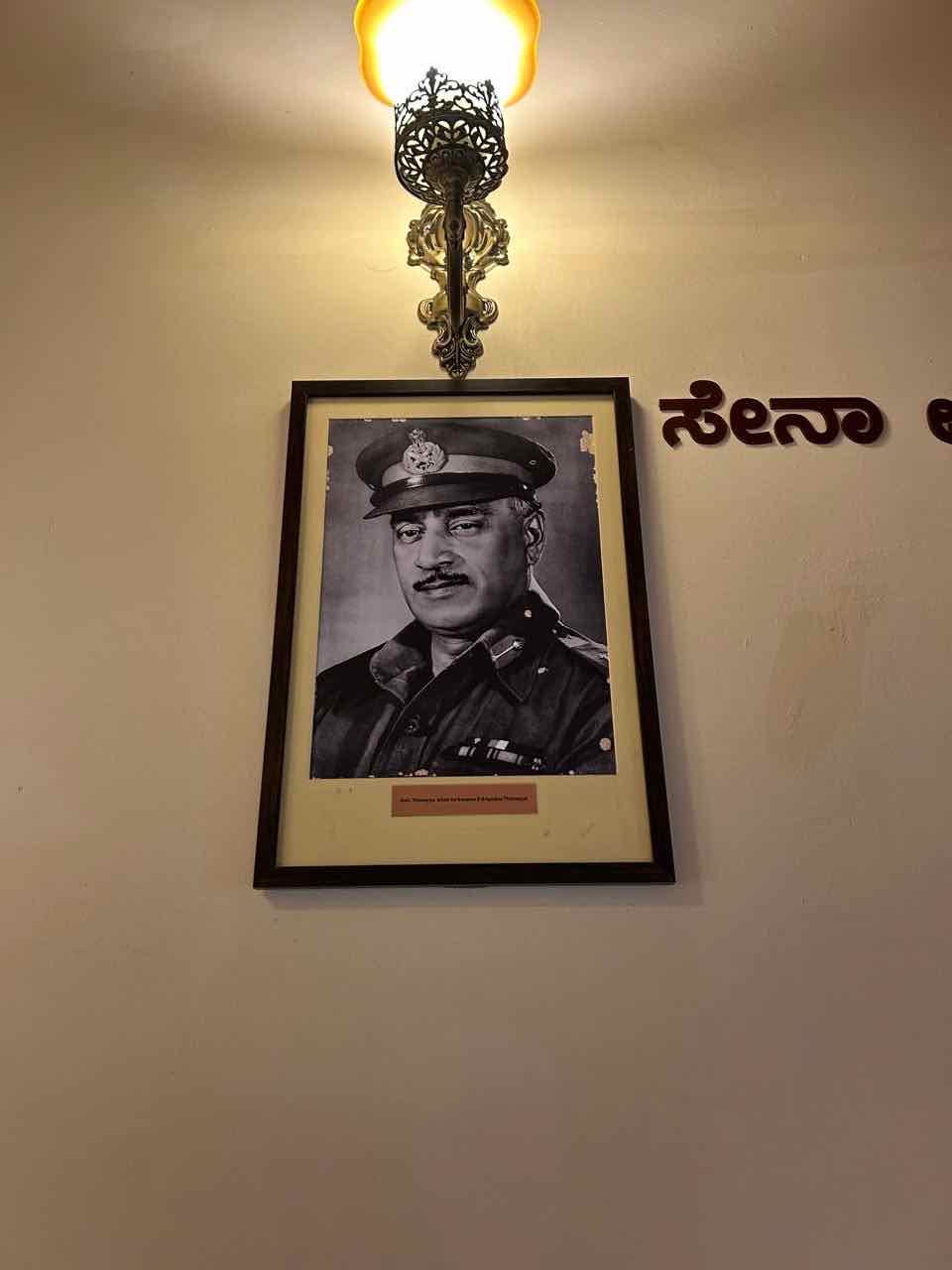
Most in my generation would agree that General K S Thimayya, DSO, (1906-1965) was one of the finest Generals to command the Indian Army. “Timmy” as he was popularly known as was the Chief of Army Staff from 1957 to 1961. As a keen student of military history, I was delighted to recently visit the Museum set up in his memory. This is in his ancestral home, “Sunnyside” in Madikeri, Kodagu his hometown.
This Museum is truly a labour of love. Those responsible must be commended for the pains taken to establish such an informative and interesting place. A fitting tribute to a great son of India. It was inaugurated by the then President of India, His Excellency Ram Nath Kovind in February 2021. The museum traces Thimayya’s life from his early childhood till his death. This is especially useful for the younger generations who may not know much about Gen Thimayya. The General passed away in 1965 while commanding the United Nations Peace Keeping Force in Cyprus.
He had an illustrious career of 35 years in the Indian Army. He was a product of the Prince of Wales Royal Indian Military College, Dehradun and the Royal Military College, Sandhurst. Commissioned in the then British Indian Army in 1926 he first served in the Highland Light Infantry as was the practice at that time. Indian officers were first attached to a British regiment before moving to an Indian regiment. His was the 19th Hyderabad Regiment which later became the Kumaon Regiment. This famous Regiment has given us three Chiefs of Army Staff and two posthumous winners of the Param Vir Chakra. Thimayya was awarded the prestigious Distinguished Service Cross (DSO) by the British during the Burma campaign.
In his exceptional career, he became the first Indian to command a brigade in the days of the British Raj. He became famous for his professional work during the 1948 Kashmir War with Pakistan. Thanks to his remarkable personality he handled two difficult assignments for the United Nations in Korea and in Cyprus.
His years as the Chief of Army Staff were unfortunately not as satisfying as he would have wished. The Prime Minister, Jawaharlal Nehru and Defence Minister Krishna Menon were seemingly jealous of his popularity. In those days military coups were quite common in Asia. They may have feared that in India too the military would carry out a coup.
Thimayya’s conduct based on his principles created more problems for him. First was the incident when he stood up to Nehru and the powerful Chief Minister of the Punjab, Pratap Singh Kairon to defend the honour of a woman. After a series of other disagreements with the Defence Minister in 1959, General Thimayya handed in his resignation. Prime Minister Nehru persuaded him to not publicise his resignation to which Thimayya agreed as a gentleman. Much to his chagrin Nehru went ahead and spoke about it in the Lok Sabha.
Many say that General Thimayya was not as effective after this unsavoury incident. His recommendations were not accepted and he lost his influence. After he retired from the Army, India – under the same leadership of Nehru and Menon- was thrashed by the Chinese in 1962. This article in the Hindustan Times has more details.
India’s loss was the United Nations gain. Post his retirement , he was requested by the United Nations Secretary General to head the United Nations Peace Keeping Force in Cyprus.
The museum is well maintained and a fitting tribute to one of India’s greatest soldiers. The moving tributes in the visitor’s book show how highly General Thimmaya is still regarded- 59 years after his death. When you are next in this beautiful part of India, please pay homage to General Thimayya by visiting this museum in Kodagu.

 Prem Rao : Stories from a Story Teller