“The Battle Of Rezang La” by Kulpreet Yadav

The defeat of units of the Indian Army at various places by the Chinese in the 1962 War left deep scars in the psyche of most Indians. However, there were a few isolated cases of incredible bravery. The Battle of Rezang La was one of them. I was 11 years old in November 1962 when the epic battle was fought till the last bullet and the last man by the valiant men of 13 Kumaon under the leadership of Major Shaitan Singh.

Kulpreet Yadav’s book, “The Battle of Rezang La” published by Penguin Veer in September 2021 is a must read for all interested in modern Indian history. It retraces the events that took place on November 18, 1962 in the intense cold at heights over 18,000 feet in Rezang La. Men of C (Charlie) Company of 13 Kumaon faced enemy forces that vastly out numbered them. The Chinese had location advantages and far superior weapons and equipment. The Ahirs from Haryana who made up C Company had raw courage and a determination not to yield an inch of Indian territory.

The 1962 Indo-China War started in October 1962 and ended in December 1962 . Short though the period of conflict was, these few months took a heavy toll of India’s soldiers. More often than not they fought with poor clothing, totally ill equipped to fight in the intense cold of the mountain areas they were tasked to defend against overwhelming odds. Of course, the War also affected India’s political and military leadership. Prime Minister Nehru was never the same again, and died within the next two years. The Defence Minister Krishna Menon was sacked and the Army Chief, Gen P N Thapar had to resign. This book details one of the battles forced upon the Indian Army by the poor strategy and vision of Nehru, Menon and Thapar.

The main difference between this and many other battles in the short war was that the Indian officers and men displayed phenomenal courage and fortitude. Kulpreet Yadav (who retired as Commandant in the Indian Coast Guard after 23 years service) writes that the debacle of 1962, where a Nehru-led India lost humiliatingly to China, was not allowed to be discussed in public discourses or books. That facts about the Battle of Rezang La were not known at all to the public at large which vastly disappointed the author. This motivated him to research this battle which has few, if any, parallels in the annals of military history.

In the first week of February 1963, a Ladhaki shepherd discovered the frozen bodies of the Kumaonis. They were found in the positions they had died, carrying their weapons with them. Most of them had many bullets in their bodies. Amongst the dead was Major Shaitan Singh, the Company Commander. He was later awarded the Param Vir Chakra – India’s highest honour for displaying acts of valour during war- posthumously.

On that day in 1963, the bodies of 96 soldier of Charlie Company were recovered from Rezang La and cremated with full military honours amid the chanting of Vedic mantras. The combined funeral pyre was lit by Brig. T N Raina, the Brigade Commander. Many years later, he became the Chief of Army Staff of the Indian Army.

The author did considerable personal research before writing this book. Being from Haryana himself, he met families of the brave Ahirs from that state who made up the complement of C Company of 13 Kumaon. He also talked to officers and men who took part in the battle, though they were not on the spot in Rezang La that fateful day in November 1962.

Charlie Company of 13 Kumaon was given the honour of being called “The Rezang La Company.” Today there is a memorial in their honour in Ladakh. The inspiration is: “To the sacred memory of the heroes of Rezang-La
114 martyrs of 13 Kumaon who fought to the last man last round
against hordes of Chinese on 18 November 1962. Built by all ranks 
13th Battalion, the Kumaon Regiment.”

I would recommend this book to all students of military history and modern Indian history. I also hope the story of the famous Battle of Rezang La will reach the youth of our country.

Operation Sindoor: A Turning Point in India’s Military Strategy

As I write this, my mind goes to the powerful address to the nation made by Prime Minister Narendra Modi yesterday evening. I think he has been the greatest Prime Minister India has ever had. It was forceful, direct, and there was no beating about the bush. Operation Sindoor was a new highpoint in Indian military history. It was triggered by the cold blooded killing of 26 Indian men who were holidaying with their families in Pahalgam in Kashmir on April 22, 2025. About seven terrorists -most likely based in Pakistan- entered the beautiful meadows. They accosted innocent men, established that they were Hindus and shot them dead in cold blood, in front of their wives and children. Seldom has the world seen such targeted gruesome killings where innocents were murdered only and only based on their religion. This was reminiscent of the Second World War when Jews were shot dead in cold blood by the SS stormtroopers of the Nazis.

India retaliated with Operation Sindoor on May 6-7, 2025. In this swift operation, which lasted just 25 minutes, 9 terror camps and establishments used by Islamist terror groups such as the Lashkar-e-Taiba, Jaish-e-Mohammed, and the Hizbul Mujhahideen were attacked with pin point precision. The terror establishments were hit hard. It is estimated that over 100 terrorists were killed in these raids. It was the first time that India had attacked terror camps so deep in Pakistan occupied Kashmir and indeed well within Pakistan itself. With this India had avenged the deaths of the innocents killed on April 22, 2025.

However, on May 8-9 , Pakistan escalated by sending in waves of drones to target Indian air stations and other military establishments. All these attacks were effectively thwarted by the Indian Air Defence System. Full credit should go to those who planned and executed this defensive network. It brought to mind Israel’s famed Iron Dome. This feat is all the more admirable as many of the components/subsystems used in this intricate defence system were indigenously developed and manufactured.

India then went on the offensive. India attacked carefully chosen airfields of the Pakistan Air Force such as Nur Khan near Rawalpindi, Sargodha, Rafiqi to name a few. Extensive damage was caused by the missiles fired by the Indian Air Force.

An uneasy calm came into effect on the evening of May 10, after the Director General of Military Operations of Pakistan called his Indian counterpart and asked for a cease fire.

The key take aways for me as a a keen student of military history are:-

  1. The shape of war as we knew it in the Indian subcontinent has changed for ever. No longer will India hesitate to attack Pakistan in their backyard. Past Governments had hesitated because Pakistan had nuclear weapons and always bragged about being ready to use them, unfettered by a No First Use policy.
  2. The use of electronic warfare, drones, etc etc have changed the contours of battle. We are unlikely to see hand to hand combat and , tank warfare on a scale that characterised past wars. The attack of airfields deep in Pakistan without Indian Air Force aircraft leaving Indian skies is a major pointer in this direction.
  3. The use of economic pressure like shelving the Indus Water Treaty and banning trade etc were aligned with the military objectives making a comprehensive unbeatable strategy.
  4. India’s resolve as enunciated by the Prime Minister of treating acts of terror as attacks upon India is a major change from the past. In earlier decades, sheltering under the story of ” Non State Actors” Pakistan used to harbour, train, and fund known terror groups. This was in line with their strategy of inflicting a thousand cuts on India. Going forward, these cuts will now come at a far heavier price than in the past.
  5. We witnessed the benefits of close co-ordination between the Indian Army, Indian Navy and Indian Air Force with the Ministry of External Affairs. We saw extensive briefings by the Foreign Secretary accompanied by representatives of the Indian Army and Indian Air Force. Later, we had media briefings by the DGMOs of the three Services. These went a long way in keeping people informed of the factual position. This helped immensely at a time when there was so much of misinformation especially on social media platforms.

The next few days and weeks will continue to be tense. More skirmishes could flare up. However, the families of the 26 innocent tourists who saw their menfolk hot in front of their eyes will have a sense of closure through Operation Sindoor.

“Kitne Ghazi Aaye Kitne Ghazi Gaye”: Lt Gen. KJS Dhillon (Retd)

Of course, I had heard of General Dhillon, especially when he commanded the Indian Army’s 15 Corps in Kashmir. I was thrilled to hear that he had published his memoirs having heard so much about this illustrious soldier. I had the pleasure of reading, “Kitne Ghazi Aaye, Kitne Ghazi Gaye” recently. This book was published by Penguin Veer in January 2023. I know he has since written another book but we will come to that in due course of time.

As an avid reader of contemporary military history, I have read the biographies of many Generals/ Admirals/Air Chief Marshals from the days of World War 2. Unfortunately, I don’t think there are many about Indian military leaders. Yes, there have been books on Field Marshal Cariappa and General K S Thimayya but not on many others, as far as I know. It was refreshing therefore to read a more contemporary account of a General of great repute who retired from active service but recently.

In his well-written book which is full of interesting anecdotes, General Dhillon takes us back to his childhood in Punjab. From a young age, he and his friends wanted to be in the Indian Army. Not surprising considering that many of their family had served the paltan. The book takes us on General Dhillon’s journey from being a young cadet at the National Defence Academy to rising to the high position of Director General, Defence Intelligence Agency. In the course of 35 years in uniform, General Kanwal Jeet Singh Dhillon had to deal with many challenges, some of which he has described in considerable detail in the book.

Perhaps because ours was, is and always probably will be a volunteer force, sadly most civilians in India have little or no idea of what life in the Indian Army entails. Conscription and compulsory military service in many countries give their citizens insights into life in the Services as many have served in them themselves. Apart from his own professional challenges, it was great to see General Dhillon write at length about the lives of the families of Army personnel. We cannot find adequate words to describe the role they play in helping our soldiers defend our borders. He writes about the challenges and hardships they frequently face and the courage with which they face these challenges.

The terror attacks in Jammu and Kashmir have taken a toll since Independence. General Dhillon has served several tours of duty in this region since 1988 and writes authoritatively about his experiences here in different capacities over the decades.

As General Dhillon exhorted his troops, ” Wear your uniform with honour and pride, which is bestowed on only the select few, and ensure you make a difference in whatever you do in the service of the nation. Your nation, army, regiment and platen is the pride that you will live and die for.”

I would strongly recommend this book – with its arresting book cover picture- to every Indian. I follow General Dhillon on X.com and suggest you do the same. After all, each and every Indian can and should do all we can to defend our country against its enemies. Jai Hind!

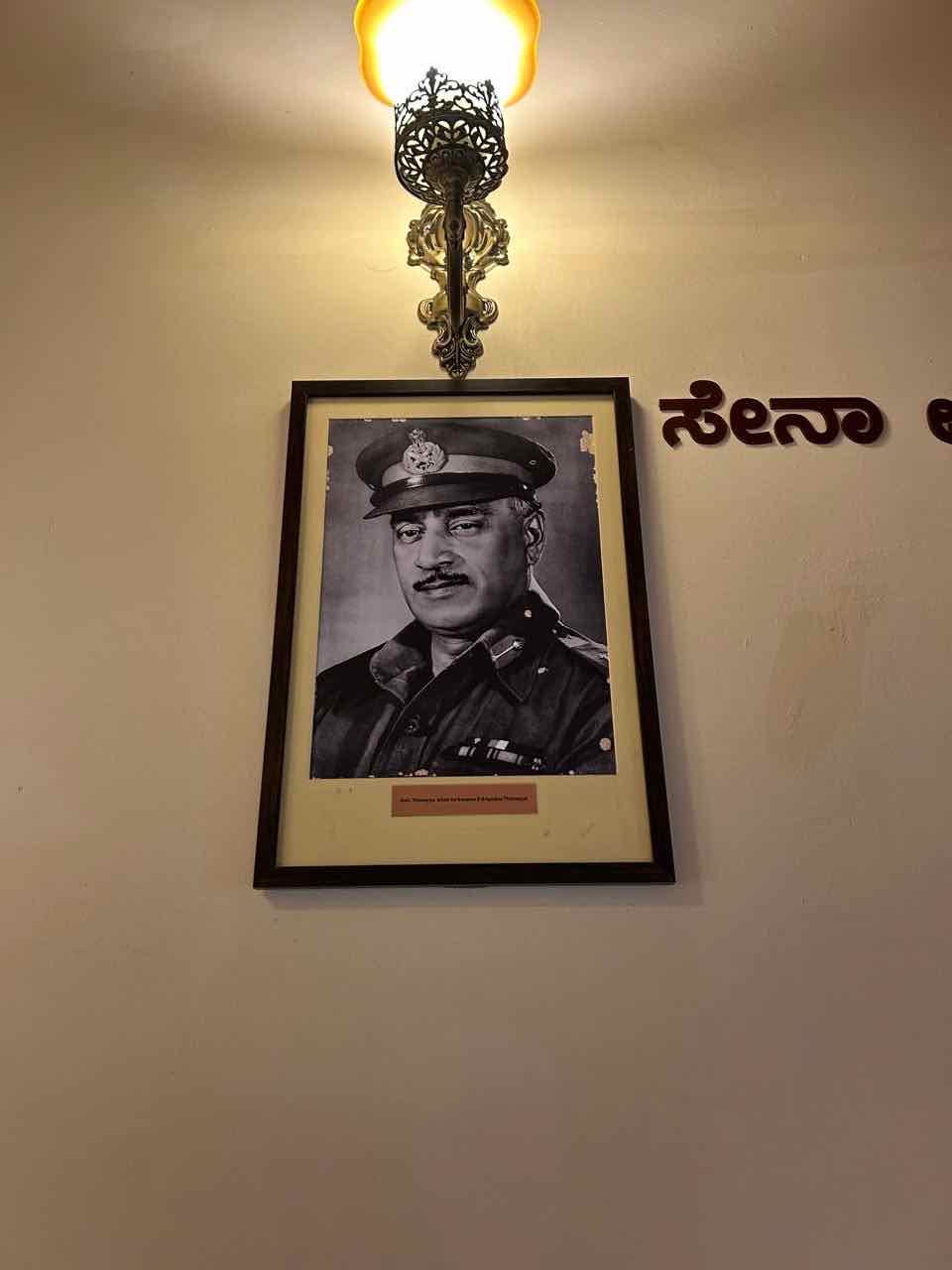
General K S Thimayya: Legacy of a Distinguished Soldier

Most in my generation would agree that General K S Thimayya, DSO, (1906-1965) was one of the finest Generals to command the Indian Army. “Timmy” as he was popularly known as was the Chief of Army Staff from 1957 to 1961. As a keen student of military history, I was delighted to recently visit the Museum set up in his memory. This is in his ancestral home, “Sunnyside” in Madikeri, Kodagu his hometown.

This Museum is truly a labour of love. Those responsible must be commended for the pains taken to establish such an informative and interesting place. A fitting tribute to a great son of India. It was inaugurated by the then President of India, His Excellency Ram Nath Kovind in February 2021. The museum traces Thimayya’s life from his early childhood till his death. This is especially useful for the younger generations who may not know much about Gen Thimayya. The General passed away in 1965 while commanding the United Nations Peace Keeping Force in Cyprus.

He had an illustrious career of 35 years in the Indian Army. He was a product of the Prince of Wales Royal Indian Military College, Dehradun and the Royal Military College, Sandhurst. Commissioned in the then British Indian Army in 1926 he first served in the Highland Light Infantry as was the practice at that time. Indian officers were first attached to a British regiment before moving to an Indian regiment. His was the 19th Hyderabad Regiment which later became the Kumaon Regiment. This famous Regiment has given us three Chiefs of Army Staff and two posthumous winners of the Param Vir Chakra. Thimayya was awarded the prestigious Distinguished Service Cross (DSO) by the British during the Burma campaign.

In his exceptional career, he became the first Indian to command a brigade in the days of the British Raj. He became famous for his professional work during the 1948 Kashmir War with Pakistan. Thanks to his remarkable personality he handled two difficult assignments for the United Nations in Korea and in Cyprus.

His years as the Chief of Army Staff were unfortunately not as satisfying as he would have wished. The Prime Minister, Jawaharlal Nehru and Defence Minister Krishna Menon were seemingly jealous of his popularity. In those days military coups were quite common in Asia. They may have feared that in India too the military would carry out a coup.

Thimayya’s conduct based on his principles created more problems for him. First was the incident when he stood up to Nehru and the powerful Chief Minister of the Punjab, Pratap Singh Kairon to defend the honour of a woman. After a series of other disagreements with the Defence Minister in 1959, General Thimayya handed in his resignation. Prime Minister Nehru persuaded him to not publicise his resignation to which Thimayya agreed as a gentleman. Much to his chagrin Nehru went ahead and spoke about it in the Lok Sabha.

Many say that General Thimayya was not as effective after this unsavoury incident. His recommendations were not accepted and he lost his influence. After he retired from the Army, India – under the same leadership of Nehru and Menon- was thrashed by the Chinese in 1962. This article in the Hindustan Times has more details.

India’s loss was the United Nations gain. Post his retirement , he was requested by the United Nations Secretary General to head the United Nations Peace Keeping Force in Cyprus.

The museum is well maintained and a fitting tribute to one of India’s greatest soldiers. The moving tributes in the visitor’s book show how highly General Thimmaya is still regarded- 59 years after his death. When you are next in this beautiful part of India, please pay homage to General Thimayya by visiting this museum in Kodagu.

“The Saga Of A Brave heart: Lt Col Ajit V Bhandarkar, Shaurya Chakra”

“The Saga Of A Braveheart” (Vij Books India, 2021) is the heart -warming and inspiring story of the late Lt Col Ajit V Bhandarkar, Shaurya Chakra (P), 18 MADRAS (Mysore) /25 Rashtriya Rifles. This courageous officer laid down his life for his motherland battling infiltrating terrorists in the Poonch area of Jammu and Kashmir in October 1999. He killed three of them before succumbing to the grievous injuries sustained in the gun fight. For his courage and exemplary leadership he was awarded the Shaurya Chakra in October 2001.

What makes the book different from most books about soldiering is that it is written by his widow, Veer Nari, Smt Shakunthala A Bhandarkar. It is most admirable that the lady put behind her own deep personal sorrow at the loss of her husband to write this book. That it was written to commemorate Col. Bhandarkar’s 60th birth anniversary and their 30 th wedding anniversary makes this story all the more poignant.

While one cannot generalise, it is true that in India sadly the civilian population, for the most part, have little idea of the life and culture of those in the Armed Forces- who defend our freedom. To this end, Mrs Bhandarkar’s objective of describing slices of life in the Indian Army for a soldier’s wife and family is praise worthy. I do hope that many, many readers will understand from her story not just how difficult it is to be a Army wife but also the magnificent support the Fauj and Faujis provide to their ilk.

The book takes the predictable path of starting from Col Bhandarkar’s childhood and school days, leading on to his experiences in the National Defence Academy and the Indian Military Academy. It continues to track his professional career as a commissioned officer in the famous 18th Battalion, the Madras Regiment (Mysore) till that fateful day in October 1999. However, what makes the story interesting and appealing is that in all these phases, his fellow officers have spoken of Col. Bhandarkar. They have recalled his abilities and character in the different capacities they knew him.

Everyone has praised his integrity, total dedication to his profession and his family, and his ability to relate to others and get the best out of them. He was clearly an effective leader on the path of great achievement.

Despite her personal loss, Mrs Bhandarkar allowed her two boys-who were just 7 and 5 when their father was killed in action – to choose their own careers . Reading about their father, I was not at all surprised that both have become officers in India’s Defence Services. Following his father’s footsteps, the elder boy Nirbhay joined his father’s Regiment 18 Madras while the younger, Akshay joined the Indian Navy.

“Life is a journey and we cannot change destiny” writes Mrs. Bhandarkar. To which level Col Bhandarkar would have risen in the Indian Army can only be speculated. Yet, on reading this book, we feel he would certainly have reached greater heights as he was only 39 when he gave his life for his nation.

I am sure Mrs Shakunthala Bhandarkar’s book about her husband will inspire many young men and women to step forward to serve in the Indian Armed Forces.

Highly recommended.

“Field Marshal Sam Manekshaw” by Hanadi Falki

I have always been a huge admirer of the late Field Marshal Sam Hormusji Framji Jamshedji Manekshaw (1914-2008) so jumped at the chance to read one more book about him. This ebook titled, “ Field Marshal Sam Manekshaw” is written by Ms Hanadi Falki. Frankly there wasn’t much in the book that one hadn’t already read about. It looked like a re-hash of arcticles, book extracts, interviews and the like. The personality of the Field Marshal is so strong, and his story so interesting however, that we feel like reading about him all over again – which is exactly what I did.

As a military commander and a leader in war and peace, Sam Manekshaw has few parallels in Indian military history. He was the 7th Chief of the Army Staff of the Indian Army- from 1969 to 1973- and his greatest contribution was winning the 1971 War against Pakistan. This led to the bifurcation of the Pakistani State and the birth of the new country of Bangla Desh.

The book traces his life and career in the Indian Amy from the time he joined the Indian Military Academy, Dehradun in 1932 in the very first batch of cadets. He served the Indian Army for four decades and fought in five wars till he retired in 1973. A grateful nation then bestowed upon him the rank of Field Marshal. He was the first General and COAS in the Indian Army to be so honored.

Apart from his exploits as a military leader, (he won the coveted Military Cross for bravery as a young officer in the British Indian Army during Second World War in Burma), Manekshaw’s character as a person of the highest integrity and professionalism stand out in the many anecdotes in the book. He had the courage to stand up to those in authority including the Prime Minister, Defense Minister and the political leadership of the country.

As I have said before, I have been and remain a huge admirer of Field Marshal Manekshaw. I am therefore terribly puzzled how under his watch India released 93,000 Pakistani Prisoners of war but did not do enough to get back 54 of our Defense Personnel, They simply did not make it back to their homeland . I was hoping that this book would cover this unsavory part of Indian military history but I continue to remain disappointed on this score.

I wish the book had been better arranged for ease of reading. It does not follow a prescribed pattern. For example, it has his childhood and early years suddenly appearing from out of the blue, much after the start of the book. However this slim volume, despite its shortcomings, remains interesting because of the man the book describes and his exploits- in war and peace.

Remembering Field Marshal Manekshaw

A couple of days ago we remembered a true hero, Sam Bahadur on his death anniversary. On June 27, 2008 , Field Marshal Sam Hormusji Framji Jamshedji Manekshaw passed away, aged 94 in Coonoor in the beautiful Nilgiri Hills. He had settled there on retirement from the Indian Army, close to the military cantonment of Wellington.

Sadly, when India’s first Field Marshal and perhaps greatest soldier passed away, neither the President of India, the Prime Minister or even the Defence Minister A K Antony  attended his funeral . Every one had some excuse or the other. Continue reading “Remembering Field Marshal Manekshaw”

G for Generals: #A to Z Challenge

For me today, G is for Generals because of my deep interest in military history. I am often asked how I developed such an interest despite never having served in the defence services. It’s not that I came from a family with a military background either though my grandfather went to Mesopotamia (as it was then known) during the First World War as a doctor with the old IMS in the British Indian Army. His son became a doctor like him and maintained the tradition, this time serving in the jungles of Burma during the Second World War. His brother served for many years in the Indian Navy being one of the earliest fliers in the Fleet Air Arm.

Continue reading “G for Generals: #A to Z Challenge”

“Little Man From The East” : Maj. Gen. M.K.Paul (Retd)

“Little Man From The East: Marching Through Tumultuous Decades” is , in my view, a “must read” for anyone interested in 20 th century Indian history. It also happens to be the story of a soldier engineer commissioned into one of the oldest Regiments in the Indian Army,  the famous Madras Engineer Group. This outfit, more commonly called The Madras Sappers, and more fondly as ‘The Thambis’ was raised  in 1780.  Major General M K Paul (retd), the author, served with distinction in the Indian Army for nearly 37 years before retiring in 1991.

Continue reading ““Little Man From The East” : Maj. Gen. M.K.Paul (Retd)”