It’s been over a month since I had a blog post here. My apologies. We were busy getting ready for our trip to the United States in the third week of February 2022. You can imagine how much we were looking forward to this trip! After all, we had been largely at home for two years or more due to the Covid 19 pandemic.
So, here we are in San Francisco enjoying a vacation with our son. This reminded me of an earlier post of March 2019 in this blog on” Humans Of New York”. I had written about how much I enjoyed the book by Brandon Stanton. I had wished someday someone would start a similar initiative in India.
I didn’t know at that time that young Karishma Mehta had started “Humans of Bombay” on Facebook way back in 2014. She writes that she started with just 10 photographs in her bank . By the end of the first day, her Facebook Page had a thousand likes, which shot up to 10,000 in the first week. I see now that over 1.3 million people have liked the Facebook Page.
You will find much more information on the “Humans Of Bombay” initiative in their website . This includes links to their blog, press coverage, and how you can collaborate with them.
Recently reading the book – “Humans Of Bombay” – , first published by Popular Prakashan in 2017- was a truly delightful experience. The stories chosen for the book are interesting, touching, and heart warming. They are so easy to relate to for one who has lived a lifetime in India.
Special mention must be made of the photographs which accompany each story in the book. They greatly enhance the interest in the story. Most of the stories are short, a page at best. A small number of them spread over a few pages while a few are made up of just a few sentences! This adds to the charm of the compilation. You will notice that in most of the stories the identity of the person involved is not disclosed.
What makes the book fascinating is that the stories cover people of different ages, religions, and economic strata of society. Yet despite the wide diversity, the issues are real, and people speak from their hearts.
If you want to experience Bombay through the eyes of an interesting cross section of its inhabitants, read this book! As you might know, Bombay has been renamed Mumbai since 1996 but old timers like me are more accustomed to Bombay. As Karishma Mehta herself writes, ‘Read this book, the Bombay way. With some cutting chai and far from healthy vada pav, and if you are away from Bombay, salivate at the thought of it. But for now, allow me to welcome you to the city of dreams.”
The Indian Premier League (IPL) is probably the richest cricket tournament in the world. Brand Finance, the renowned brand value consultancy pegs its value at $4.7 billion! Naturally, it attracts players from all the major cricket playing countries, and some of the lesser known ones too. Decades ago, the emoluments of India’s cricketers was really measly. They used to envy players from the so called ” developed” countries such as England, Australia, and New Zealand for their compensation. The wheel has turned full circle. In the last decade, players from these very countries hope for a lucrative IPL contact – these could change their fortunes!
This year’s auction was held recently at Bengaluru and 204 players including 67 from overseas were sold for Rs 551 crores. For the uninitiated -in India 1 crore is the equivalent of 10 million. Unlike the last few years, this year there were 10 franchisees bidding for the players with the addition of two new franchisees, the Lucknow Super Giants and the Gujarat Titans.
As if the fast paced action at the auction was not enough, there was a moment of apprehension when the widely respected auctioneer, Hugh Edmeade collapsed and had to receive immediate medical attention. Fortunately he not only responded well to the treatment but was back in action for the concluding part of the auction on the second day!
In Edmeade’s absence, the auctioning was done by Charu Sharma. Overall, he did a good job, I guess. However, I felt at times he was not consistent enough to be a good auctioneer. For some players/teams he was quite liberal with the time he gave for them to decide, for some others he wasn’t half so generous. I also felt he could have been a little more considerate for the young uncapped players. For them this is a make or break opportunity, so maybe a standard time could have been set. We saw some were declared unsold within seconds while others were given more time, which I thought was not fair.
Every IPL auction has its stars who draw the biggest bucks. This article lists the most expensive players over the years, starting from 2008. We have seen, though, that not all of them were very successful in that year. Possibly the sheer pressure of being the highest paid falls heavily on their shoulder. When people begin to calculate how much you cost per ball bowled/faced – you can imagine the pressure the player has to go through!
This year, young Ishan Kishen was the biggest gainer, being paid Rs 15.25 crores to be bought back by a team which did not retain him in the first place, the Mumbai Indians. Each team, as you know, were allowed to retain a maximum of four players, who then would not go into the auction. This brings me to an interesting observation. Should there be a minimum amount fixed for retained players? I ask because many who were not retained got far more by way of the auction. They were better off not being retained!!
The auction went off without a hitch, but there was a controversy when Charu Sharma declared Khaleel Ahmed sold to Delhi Capitals when really he should have gone to Mumbai Indians. He can perhaps be excused as there were so many players to be sold!
The players have made their contracts , now they must earn the big bucks spent on them on the cricket field!
On January 23, 2021, I wrote a blog post here titled, ” Salute To Netaji Subhas Chandra Bose” . One more year has gone past and I see far greater interest in the life of this iconic Indian leader than ever before. This is evidenced by a recent event that took place in New Delhi, which I consider momentous.
On January 23, 2022, Netaji’s 125 th birth anniversary , Prime Minister Narendra Modi announced that Netaji’s statue would be built at a prominent spot near India Gate in our capital city of New Delhi. Netaji’s birth anniversary is being celebrated as Parakram Diwas honoring his courage and that of his troops- men and women- who fought for India’s independence. As many of you will know, Netaji was at the forefront of the war for independence and his Indian National Army or Azad Hind Fauz fought the British troops in important battles such as the one in Imphal in 1943. It is perhaps in the fitness of things that Netaji’s statue will be in the same spot where once stood the statue of the British King Emperor George V !
The target date for its inauguration has already been announced as August 15, 2022, India’s Independence Day. Till the statue is made ready, we will have a hologram of Netaji ‘s statue on display. This hologram is 28 feet high and will be powered by a 30,000 lumens projector.
For the youth of today who may not know much about Netaji as our history books have very little on him, a few facts are worth recounting. In October 1943, Netaji established the Provisional Government of Free India in Singapore which had fallen to the Japanese during World War 2. He was the Head of State and Prime Minster. Currency in the name of the Free India Government was also printed by the Azad Hind Bank. These were more by way of promissory notes that would become official currency once the British were driven away. “Subh Sukh Chain” was declared the national anthem of Netaji’s Free India and the Sher-e-Hind was the highest military honor instituted by Netaji for the troops of the Indian National Army.
Since the close of World War 2, the story of Netaji Subhas Chandra Bose has seen many twists and turns. There have been so many versions of his death. No one quite knows the truth. A new book will be published in February 2022 which promises to be interesting. This is “Bose: An Untold Story Of An Inconvenient Nationalist” by Chandrachur Ghose. I, for one, look forward eagerly to reading this.
January 19, 1990 may be just another date for you and me. However, for the thousands of Kashmir Pandits who had to flee their homeland leaving behind everything, this date will never ever be forgotten.
Today, on January 19, 2022, if we look back at that tragedy, it is fair to say that the Kashmiri Pandits still await justice. A short recapitulation of events that took place in the Muslim-dominated State which was then called Jammu & Kashmir is given in my blog post of January 22, 2020 titled, ” How Kashmiri Pandits Lost Their Azaadi”.
Today, I saw so many tweets from displaced Kashmiri Pandits that are touching. “32 Years and counting. Our genocide is forgotten” says India 4 Kashmir; ‘Exodus of Kashmiri Pandits. What About Our Human Rights? ” asks Gita S Kapoor; ” Shameful that even after all these years, the wiping out of a community from our own land is Not recognised as a Genocide, as an act of Civilizational Terrorism. Justice Delayed is Justice Denied” tweets Rati Hegde; . These are but a few of the many tweets expressing anguish that not much has happened to bring those responsible for such targeted human suffering to book.
Shedding blood on religious lines is not new to India as our country was born with this as the gory backdrop. I suggest you read my review of ” The Holocaust of Indian Partition: An Inquest” by Madhav Godbole. for perspective of those far away days. The British were in hurry to leave India, and our politicians were in a hurry to grab power. No one imagined the short term consequences and the enormous cost in terms of human suffering.
After the gruesome murders and carnage that took place during the Partition of India, two events stay in the memory as blots in our “secular” society- the first was the Sikh Massacre in 1984 often toned down to be called Anti-Sikh Riots!! Do read my review of books on this subject elsewhere in this blog. One of them needs particular mention, ” When A Tree Shook Delhi” by Phoolka and Mitta
The second was the Massacre of Kashmiri Pandits in 1990. A book worth reading is Rahul Pandita’s, ” Our Moon Had Blood Clots” published in 2013 which captures his memories of fleeing Kashmir as a 14 year old in 1990. No one knows the true figures but certainly hundreds of Kashmiri Pandits and their family members were raped, killed, or brutally injured when they- over 350,000 of them- were terrorized in leaving their home by pro- Islamic mobs. Why the then Prime Minster, V P Singh did not call out the Indian Army to bring about peace in Kashmir is anybody’s guess. Perhaps he hesitated because he himself had been elected to power only a month or so ago, and did not want to rock the boat of a fragile coalition which he ran.
How the story of the Kashmiri Pandits will end is anybody’s guess. It is astonishing that for far lesser crimes, thousands all over the world -especially certain NGOs -scream about the abuse of Human Rights and Democratic Values. For the hapless Kashmiri Pandits, sadly, there hasn’t been a whisper from them- just a frosty silence. Strange are the ways of our democracies in recognizing and addressing human suffering.
Have you come across Nandini Rao, teacher in Bul Bul Vidya Mandir? Or, Reena Dalal, India’s biggest Makaan Matcher? You will recognize her as the same lady who speaks on National Doctor’s Day, On Goal Setting, On Adoption of Stray Dogs, and on HR practices with equal flair and aplomb. She is none other than Aiyyo Shraddha, who has 1.55 lakh subscribers for her YouTube channel, 20k followers on Twitter, 352,000 followers on Instagram, and 318,000 followers on Facebook!!
Shraddha, is for me, one of India’s best entertainers on view at present. In a world of stand up comedy, where it is considered fashionable in some circles, to have vulgar language, with a lot of f’s and b’s and other expletives thrown in for good measure, she stands apart for her clean- yet remarkable funny shows.
Her shows are what in the old days used to be described as “family” shows. This means -from the grinning 8 year old to the gurgling 80 year old- all can understand and appreciate her wit and humor. Her themes are based on current goings on and naturally topics like Covid, work from home, and all that is going on around us feature in one form or another.
Shraddha, I understand, is a girl from Mangaluru who grew up in Mumbai- hence the mastery over Marathi shown from time to time in her shows. She is equally adept at English, Kannada, Tulu, and Hindi. This is a useful part of her armory, where she can adapt to different roles. Talking of which she plays several roles in the same episode. In a popular series, she is a young lady herself, besides being both her mother and her father!
Like in most middle-class Indian families, her parents too encouraged to do well in academics. Predictably, like many of her background, she completed her engineering and worked for a few years in the IT industry. She then realized that her true calling was in entertainment. She was a RJ in a popular Kannada channel Fever 104FM for nine years. I think the creative resume she sent was one of the best I have ever seen.
Later she became a host/anchor in Colors Kannada and later head of non-fiction content there. She is now on her own, producing , directing, filming and acting out her content on different social media channels. She also played the role of the fiesty landlady of a Women’s PG in Bengaluru in the Amazon Prime hit film, “Pushpavalli”.
In case you haven’t seen her shows yet, do check them out. I am sure those expressive eyes and knock out punch lines will draw you back to her shows, as they do for me.
Growing up in the South of India, I knew about the practice of Kolu or Golu during the Navratri festival. In many houses in the locality where we lived, dolls were unpacked with care, arranged tastefully and exhibited for all to view and admire. This was called Bommai Kolu in Tamilnadu and Gombe Habba in Karnataka. The lady of the house often stood there proudly looking on with approval at the elaborate display. Later it became common to have some kind of theme built into the display of dolls.
When I visited Gujarat many years later, I saw an entirely different way of celebrating Navratri. This was through the Garba and “Dandiya Ras” with the ladies swaying to the beat in colorful costumes. I had never seen anything so vibrant and colorful in my life! Later, In West Bengal, I experienced the grandeur of the Durga Puja pandals and all the associated celebrations. Years have passed by, but the beat of the drums while the ladies performed the “Dhunuchi Naach” stays fresh in my mind.
These and more memories flooded my mind when I read the recently published book, ” Navaratri” edited by Bibek Debroy and Anuradha Goyal, published by Rupa Publications. “When Devi Comes Home” is the appropriate byline as we Hindus believe that it is during these nine days/nights that Devi visits us here on earth. The editors have assembled a collection of 16 articles which depict how Navaratri, one of the most important of festivals in Hinduism is celebrated in different parts of India. The descriptions cover not just the background of the festival in each region but the rituals most commonly practiced, along with the other associated elements including food, customs, and cultural events.
Amrita Chakravorty’s book cover design is captivating. It attracts you to read the contents. The book itself is written in fairly simple language and makes one marvel at the rich cultural heritage of our country. From Kashmir in the north to Kerala in the extreme south, from Gujarat in the west to West Bengal in the East, we are exposed to how the Navaratri festival is celebrated in each of the regions. Needless to say, though the festival of Navaratri has some common elements , it is interesting to note both the similarities and differences, explained in the articles. This diversity adds considerably to the charm of our customs.
As the editors explain, ” The common thread among all the Navaratri celebrations is the devotion to Devi, who is also the Prakriti or Nature manifested all around us, of which we are a small part.” The editors have arranged the book in 16 chapters which pretty much cover the entire country. I was happy to see that celebrations in places like Konkan and Assam -which tend to get ignored as compared to the bigger and more famous celebrations elsewhere- were also covered. There is a chapter too on Nepal, the only Hindu country in the old today.
In the nine days of Navaratri, Devi is worshipped in Her different forms. This book makes you feel as if you are physically there- in the midst of the frenzy that typifies community worship. So well are the rituals and cultural events described! You can sense the smells and sounds of the celebrations as if you are there in person to join the thousands of worshippers.
Congratulations to the editors for bringing this book to us. It is extremely informative about the origins of the Navaratri festival and explains why and how Devi came to be worshipped in a particular manner in one or the other region.
Many of you will be familiar with quotations from the Bhagavad Gita, the timeless wisdom given by Lord Krishna to Arjuna on the battle field of Kurukshetra. These have taught millions of Indians- and increasingly people of other countries all over the world- a set of principles to lead their lives. A kind of moral compass, if you will.
One of the most quoted is, “Do everything you have to do, but not with ego, not with lust, not with envy but with love, compassion, humility and devotion.” Judging by both his actions and words, I can think of few people who have followed this advice as effectively and successfully as Mr Yajna Narayana Kammaje, the Chairman and Managing Director of the privately-held Sona Group of Companies, headquartered in Bengaluru.
The book I review today – “Business As ‘Yajna'”– is about this gentleman. It tells us how he succeeded as a first generation entrepreneur. Apart from this, he positively impacted the lives of thousands of people, many of them from rural areas and from the economically lower strata of our society.
The title itself is quite intriguing. It combines two elements, Yajna Kammaje’s approach and thoughts about doing business and “Yajna” as a person- with a clever play of words. The book was recently released in Bengaluru and described as “Life Lessons from Industrialist: Yagna Narayana Kammaje.” The lead author is Mr B Anantha Bhat, who has worked in the VLSI/Semiconductor technology field for over 30 years in India and abroad. He is an entrepreneur himself. The key drivers of this initiative are some dedicated folks from the National Institute of Technology-Karnataka ( NIT-K)Alumni Association.
Yajna has close ties with this venerable institution which started as the Karnataka Regional Engineering College (KREC) at Surathkal, near Mangaluru in 1960. He did his B.Tech in Electrical Engineering in 1971 and M. Tech in Industrial Electronics in 1973 from this institution.
He was the President of the Alumni Association for many years. In this field too, he excelled. He did more than anybody else in recent times to build and nurture this body. It is now a vibrant alumni association with active members from all over the world.
The lessons from this book are really directed towards entrepreneurs and would be entrepreneurs. In the India of 2021, it is quite common- and indeed somewhat fashionable in some circles- to talk of entrepreneurs, start ups, venture funds and angel investing.
Things were vastly different in the 1970’s and the decades that followed. For most people a secure job was probably the most important thing in their lives. In such a milieu, Yajna, then a rising star of the famous HMT, who had rapidly grown to the position of Dy General Manager in the Watch Division and clearly ear marked for higher responsibilities chose to give it up and strike out on his own! Considerations that most people would have worried about like having a wife and two children and other family to support, did not come in the way of his dream to start and grow a business. Not just to make money for himself – though of course this was an important parameter – but to give back in good measure to society at large and the less affluent in particular. The second would have been the farthest in the thoughts of most people in such circumstances.
In this venture, immense credit is due to his wife Smt. Vasanthi Kammaje who stood by him like a rock through thick and thin. She has made very significant contributions towards his success as an entrepreneur and a philanthropist, since they began their entrepreneurial journey in 1987.
As a student of human behavior, I have seen that often when someone is in need, those with “less” are the first to give while those with “more” are the most reluctant. Likewise, as a proportion of what they have, those with less tend to be far more generous than those with more. Yajna, in my view, is an exception to this general rule. He gave in plenty when he didn’t have much and he continues to give in plenty as he became more wealthy. Charitable causes, religious causes, people in need, employees, vendors, budding entrepreneurs and many others have benefited from his generosity. Often they return with more than what they hoped for, if he thinks theirs is a right cause to support or their need for help is genuine.
What has shaped him to be what he is today? Clearly his disadvantaged start in life has. He came from humble economic origins and knows, more than most, what is means to tb economically disadvantaged. As a consequence, all his life he has worked hard, and worked smart. He has demonstrated his risk taking ability on many occasions- the true differentiator between a real entrepreneur and others who go by that name.
The book is made up of contributed articles by people who have known him and his work. They are too many to list here but they have impeccable reputations and records of distinction in their professional lives. It is written by his professional colleagues, friends and admirers and many who have benefitted from their association with him.
On a personal note, I am proud to know Yajna for a decade or more as we live in the same apartment complex in Bengaluru. Besides, he is from Siddakatte a small village in the Bantwal Taluk of the Dakshina Kannada District of Karnataka. And, I happen to belong to Bantwal! Shobana, and I were honoured to receive a copy of the book from Yajna recently.
“Business As ‘Yajna'” is printed and published by Tik-Talker & TradePost and can be ordered through Amazon. I would urge not just those who wish to become entrepreneurs but indeed any one in business to read this book. It is replete with lessons on how to conduct oneself with humility and consideration for others while being successful in business.
Some books are truly inspirational. That’s because the characters in them touch your heart and move you to action. I would rate “Dark Horse” by General Larry O. Spencer, USAF (Retd), as one such book. He came from fairly humble circumstances, being born in 1954 to a African-American family in a tough inner-city area called The Horseshoe in Washington DC. He enlisted in the United States Air Force at the lowest level as an airman. After 44 years of distinguished service he retired as a four-star General and the Vice Chief of the United States Air Force. He was only the ninth African-American to get four -star rank. His is an extraordinary story of grit, commitment to his profession and an ability to aim high and achieve his goals. He became and remained a top achiever despite many challenges that came his way.
General Spencer’s story is all the more remarkable because as a student he was considered a failure. The circumstances in which they lived didn’t help. His father was a US Army veteran who had an arm amputated following war wounds in the Korean War. He had to wear a prosthetic arm and was derisively called Captain Hook by the kids in the neighborhood. His mother wasn’t well-educated either having studied till the 10th grade. Theirs was a family with 6 growing children. His parents naturally faced a lot of hardship in making both ends meet, with his father working at two jobs to bring home enough to feed his family.
Larry Spencer, like most African-Americans of his background, thought the way to break away from poverty was to succeed in professional sport. He wanted to become a star football player. In 1971, he enlisted as an airman in the US Air Force as there was no assurance that he would succeed with a career in football. In the Air Force there was an opportunity for him to study and better his life. He served a stint in Taiwan and after his first spell in the USAF, he decided to re-enlist so that he could work towards becoming a graduate.
An encouraging supervisor suggested he try for Officer Training School after his graduation. He was selected and became the first person in his extended family to become a commissioned officer in 1980. Many of his family and friends were in the US Military but none of them were officers. He had broken a huge barrier.
Over the years, Spencer felt the hardships that commonly came the way of African-Americans in the 1970s and 1980s, even when he wore the uniform of the United States Air Force.
He was a committed professional, held himself and others to very high standards and worked with great passion for his profession. Perhaps because he was not a trained pilot but served in the financial management area of the USAF, his rise to higher positions saw him break more barriers.
General Spencer writes with a lot of candor on how he coped with difficult and challenging situations in his career. Needless to say, many of them were because he was an African-American.
More than the high command positions he held or his professional achievements, laudable as they may be, the book’s value lies in our understanding of General Spencer as a person. We see how he succeeded against the odds. We marvel at the way he emerged to be the dark horse in horse racing parlance. And, last but not the least, General Spencer leaves us with a crisp summary of his life lessons, which are invaluable.
Overall, an inspirational book about an officer and a gentleman.
It was a delight to read, “Lights! Wedding!Ludhiana!” by Jas Kohli, published by Rupa recently. I came to know that Jas Kohli is actually a well-known cosmetic surgeon who has written two novels earlier in the same vein as this one. They are titled, ” Lights, Scalpel, Romance” and ” Anything To Look Hot!” Judging by the book I just read, I think I must add the others by Dr Jas Kohli to my library list!!
The plot of his book is fairly straight forward. Kushal, an industrialist in Ludhiana who would love to be an activist to protect the environment more than anything else, is caught in a jam. His hyper active young son, Lakshya has discovered from his phone that he is getting messages from an old flame from his college days. Kunal’s wife, Reeti, a good looking free spending beauty is aghast, as are his parents. Dr Kohli covers what happens next in an interesting and entertaining manner.
The earthy language and slang used in Ludhiana, the social norms prevalent there, the hunger for fame, food and booze, are brought out extremely well in this book. We also come to know of the high expectations from Ludhiana society whenever a Big Fat Punjabi Wedding is planned and taking place!
What I liked best of all was the accurate characterization of the people involved. Apart from those already mentioned, we come across Kunal’s parents, Kimti and Tripta ( with their own stories to be told); his daughter Vanya, a typical teenager of today, and assorted others. On reading the book, we feel we know these people ourselves.
A typical Punjabi wedding with all the grandeur and the noise provides the backdrop to much of the story. Here again, the author’s description of people and their behavior demonstrate his skills in wielding the pen ( figuratively if not literally) as well as he does his scalpel.
All in all, a light read, and fun too! I am prompted to read Dr Jas Kohli’s other books having sampled this one.
Let me start by saying that Sathavalli Govindarajulu Gopinath, or just Gopi to his friends all over the world, counts as being one of my oldest friends. He and I have been friends for many, many years now. Over 60 years to be precise. This clarification is necessary because once when I introduced someone as being my oldest friend, the person whom he was being introduced to said, ‘ Oldest friend? But he doesn’t look that old. In fact, you look older than him.”
Gopi joined The Lawrence School, Lovedale a year before I did. When I started there in the 3rd Standard in 1959, Gopi had already been there for a year having joined in the 2nd. Since we are talking about his book on his family, the story of how his Dad left him at the Prep School is still fresh in my mind. We studied together till we left School in 1967. He did his engineering at the famous old College of Engineering, Guindy, in Madras, following the footsteps of his father who studied there from 1941 to 1945. Gopi was the University topper, in 1973. He then went to the US to complete his MS from the University of California, Berkeley.
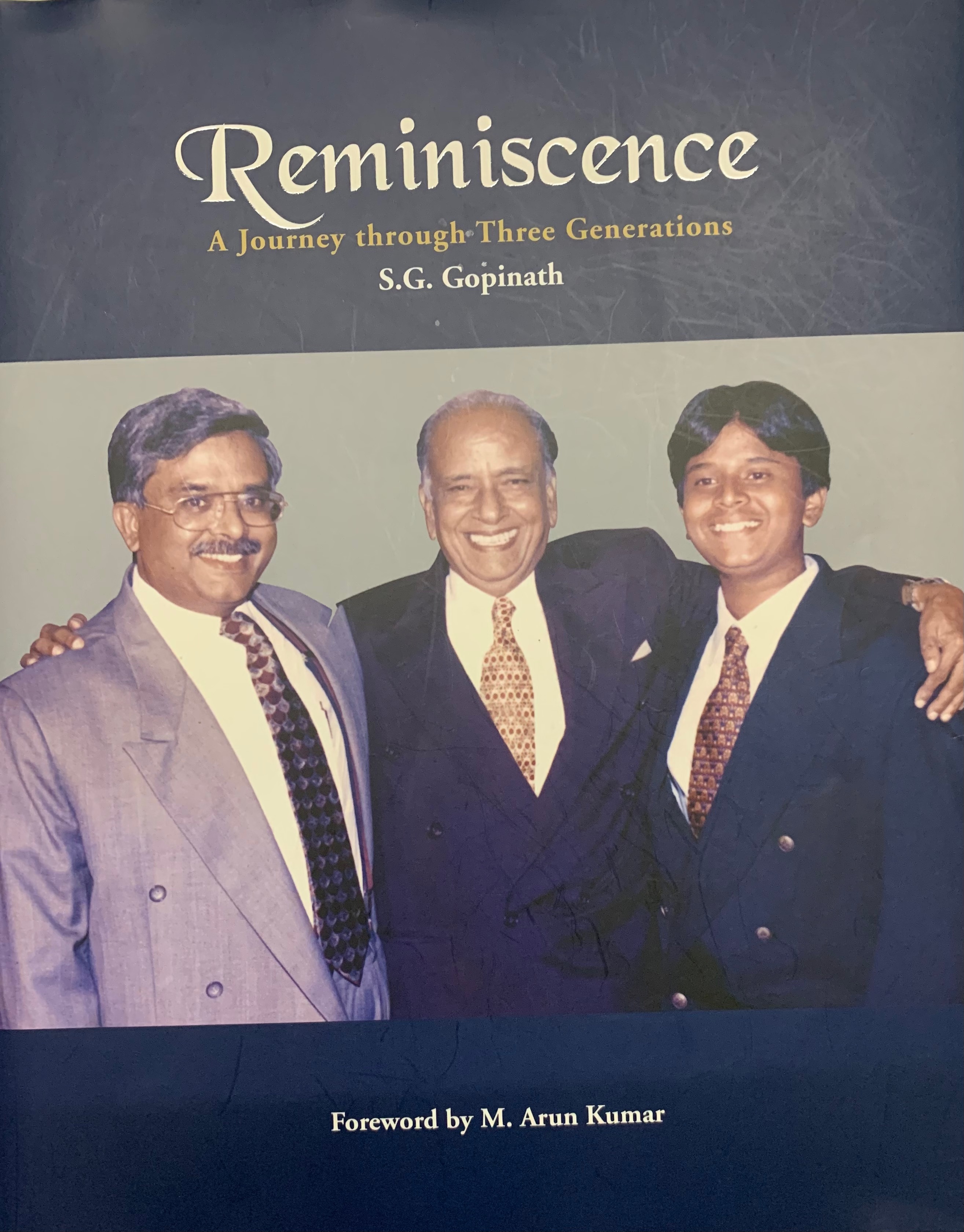
‘Reminiscence: A Journey Through Three Generations” is the history of his family.
Often people mix up the history of the family with family history. The two are not, I believe, interchangeable. “Family history” is more from the domain of medicine. ” Did one or both of your parents have diabetes?” ” Did your grandparents die due to heart ailments? ” are questions we are frequently asked as the doctor pieces together our family history to help her make a more accurate diagnosis and treatment plan.
In India, it is not so common but in the United States many undertake, as Gopi did, to chart the history of their families and write about the larger family in the form of a book. Gopi has written a comprehensive and interesting account of his family focussing on three generations, his father’s, his, and his son’s. Gopi’s book therefore is in three sections: the first about his parents; the second about his own journey and the third and last about his children.
This book is, I understand, for a restricted audience and hence is more like a coffee table book. It has been produced quite tastefully, printed in expensive glossy paper and is replete with photographs from family albums. How Gopi found the time and energy to put them together like this is quite amazing. I would imagine that writing the history of one’s family can be most demanding, and often rather risky. The writer throws himself or herself open to criticism from uncles, aunts, cousins and other relatives, close and distant. They demand to know why you wrote something about them or why you did not write something else about them! I am sure Gopi has faced his challengers boldly with the School motto, ” Never Give In” being an inspiring force.
This history of his family starts with his grandparents and the first part is largely about his parents. His father, Mr S P Govindarajulu, worked for all his working life in the Military Engineering Service. He rose to become the Chief Engineer before he retired in 1981. This part of the book will bring back many memories for all of us, as the incidents described are evocative of one’s own childhood. In those days families were much bigger and tended to be more close knit than they are today. In any case, Gopi’s father had a larger than life personality and was universally popular. His mother was the ideal support for the family and was a big influence in Gopi’s life.
I naturally found the second part most interesting because it is about my friend and the School we went to. I feel honored that Gopi has a picture of me in his book. I think I made the cut because I edited, “Glimpses Of A Glorious Past: An Informal History of The Lawrence School, Lovedale”. The school stories brought back many memories. Gopi has been very candid and describes incidents which many would have quietly skirted away from, like how bunking from School lost him the definite probability of becoming a House Prefect in our final year. The book then covers his professional career and his growing family, and their lives in different parts of the world.
The last part is the most touching, and I think the reason why he wrote the book. It is about his son, Venkat (S G Venkatraj) whose promising career sadly came an end when he passed away while working in the United States. The book moves into a different plane in this section. One can feel the agony of Gopi and Beena, his wife, as they try to come to terms with a devastating blow to their lives. The years go past, as they will, but some memories stay forever. His daughters – Rohini and Rukmini- have contributed too by sharing events from their perspective.
I praise the book, not just because Gopi is an old friend, but because it has clearly been for him a labour of love. That is reflected in the writing, the design, and the overall get up of the book. Successive generations can read about the family legacy, and about the stalwarts who shaped their family culture and values. Indeed, it is a precious gift he has crafted for his daughters, and his grandchildren. Well done, Gopi! Take a bow!!


 Prem Rao : Stories from a Story Teller